

SOUND ABSORBING
Thanks to high sound absorbency, Onduline contributes to a quieter atmosphere inside homes. Bitumen, as a viscoelastic material, has the capacity to absorb sound by transforming vibration into heat.
ONDULINE® sheets contribute to a 4 times quieter atmosphere inside homes than metal sheets (difference of 23 dB in favour of Onduline®).1
Learn more below!
1 Test report BBTA3.TR.20.00023.R performed on 3 mm thick ribbed metal sheet - ISO 140-18:2006 in comparison with ONDULINE® CLASSIC 3 mm
Discover how fONDULINE® roofing sheets absorb sound!

How to explain the capacity of ONDULINE® sheets to absorb sound?
Best known for its waterproofing capabilities, Bitumen has also proven to be particularly effective for sound absorption, as Bitumen is a viscoelastic material, which means that it has the capacity to absorb sound by transforming vibration into heat. Bitumen reduces the transmission of vibrations caused by external sources. That’s why bitumen is also used as a heavy mass around car engines and in washing machines, among other, as a soundproof material.
To sum up the advantages of using bitumen for sound absorption are:
- A unique combination of properties: bitumen exhibits viscoelastic behaviour due to its ability to combine both viscous (dissipative) and elastic (restorative) properties when subjected to mechanical stress. This characteristic enables bitumen to absorb and dissipate mechanical energy, including vibrations, which contributes to its damping capacity.
- Damping of vibrations: viscoelastic materials are excellent at damping vibrations and converting mechanical energy into heat. When sound waves propagate through these materials, the vibrations are quickly dissipated, reducing the amplitude of the waves and preventing them from reflecting back into the environment.
As a viscoelastic material, exhibits good damping vibrations capacity due to its combined viscosity and elasticity. The material's ability to dissipate mechanical energy through internal friction makes it effective at attenuating vibrations and absorbing sound energy. This property has practical implications in various fields, contributing to sound absorption, noise reduction, and improved acoustic environments.
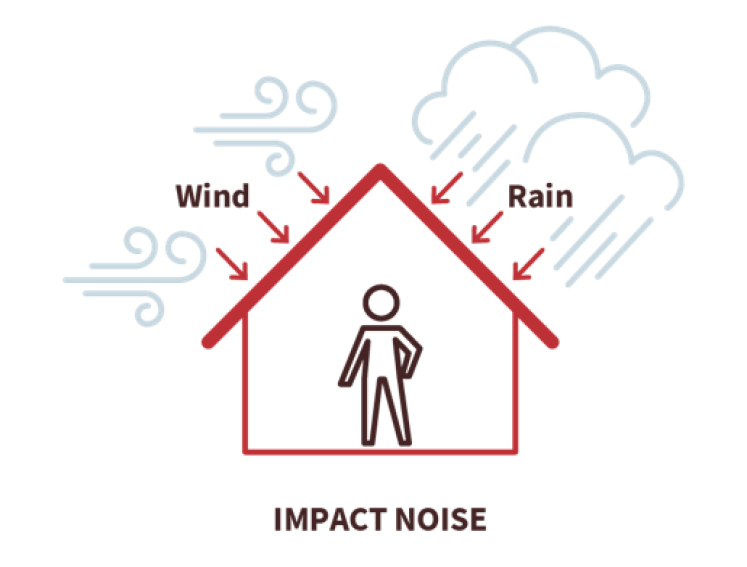
What kind of sounds are we talking about?
ONDULINE® sheets are particularly effective to absorb impact noises such as rain, wind, fallen debris (leaves, branches) ...
Sound absorption is very appreciated by people living, working or learning under.
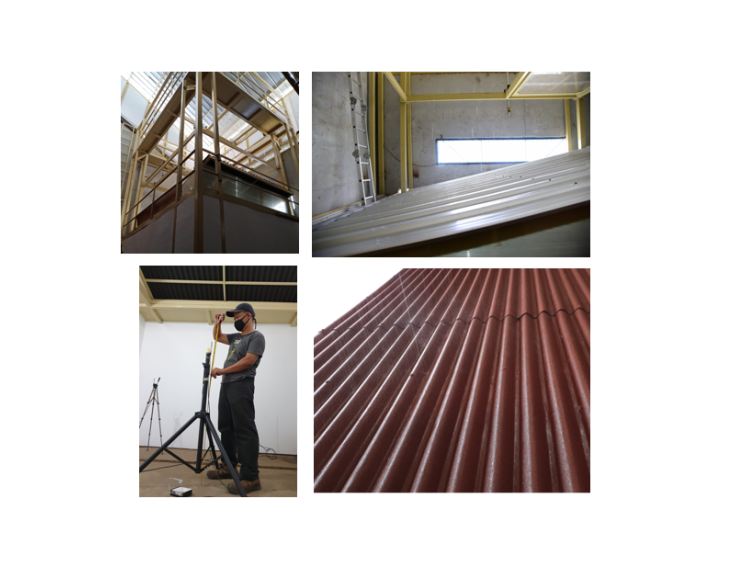
What is the sound attenuation coefficient of ONDULINE® sheets?
For impact noise, the measurement parameter used is the impact sound pressure level reduction index, which is indicated as ∆Lw (dB) and represents the improvement introduced by an ONDULINE® sheet. For comparison purpose, a metal roofing sheet (thickness of 3 mm – ribbed profile) has been compared to an ONDULINE® CLASSIC sheet on simulated roof settings and rainfall conditions (Test Report BBTA3.TR.20.00023.R).
- The metal sheet generates 83,09 dB(A) where the ONDULINE® sheet generates 59,88 dB(A): a major difference of 23 dB(A) and a very good performance for a roofing material of only 3 mm!
- Noise measurement was performed, at constant rainfall, using five microphones inside the rooms.
- The switch from 60 to 83 is a major difference. Below 60 dB(A), we can have a normal conversation, whereas it becomes really disturbing to overpass 80 dB (A). For example, 80 dB(A) is the level of a high traffic street or klaxons, a garbage disposal or a piano practice.
We can clearly hear the difference between the metal sheet and the ONDULINE® sheet!
Reducing from 83 dB(A) to less than 60 dB(A) is life-changing. It means that with ONDULINE®, the indoor environment is 4 times quieter than with a metal roof. Thanks to its unique composite material, ONDULINE® roofing generates less noise under rainfall. This reduction of noise has been officially tested by an independent third-party laboratory, the BPPT (Indonesian National Laboratory for Aerodynamics, Aeroplastics, and Aeroacoustics technology), and measured according to ISO 140-18:2006.
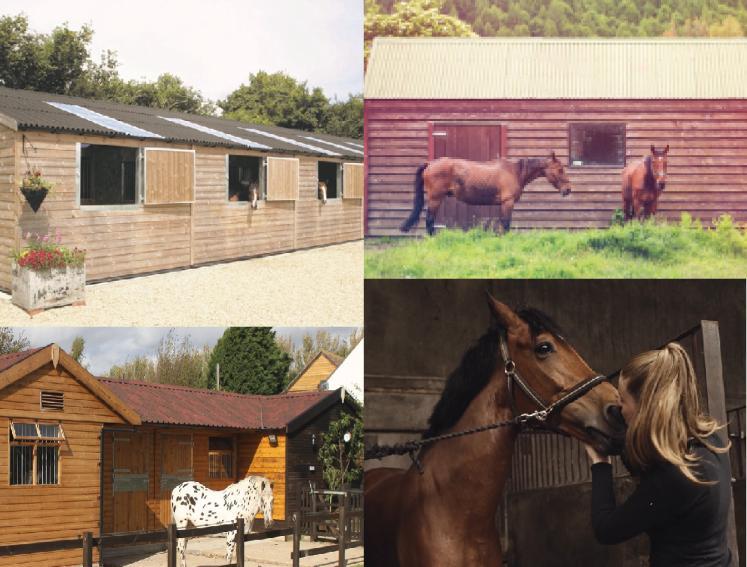
Onduline is the preferred roofing systems for stables
Horses feel safer during storms thanks to Onduline®!
Like many animals, horses are easily afraid when environment is noisy. During storms, they may feel particularly unsafe because of the rain noise.
While other roofing materials let sounds go through, ONDULINE® sheets absorb part of it. As horses feel safer, lots of UK owners choose, repurchase and recommend ONDULINE® sheets for stables.